A practical Bebiyu guide to make counting a relaxed, hands-on, and interactive part of everyday life.
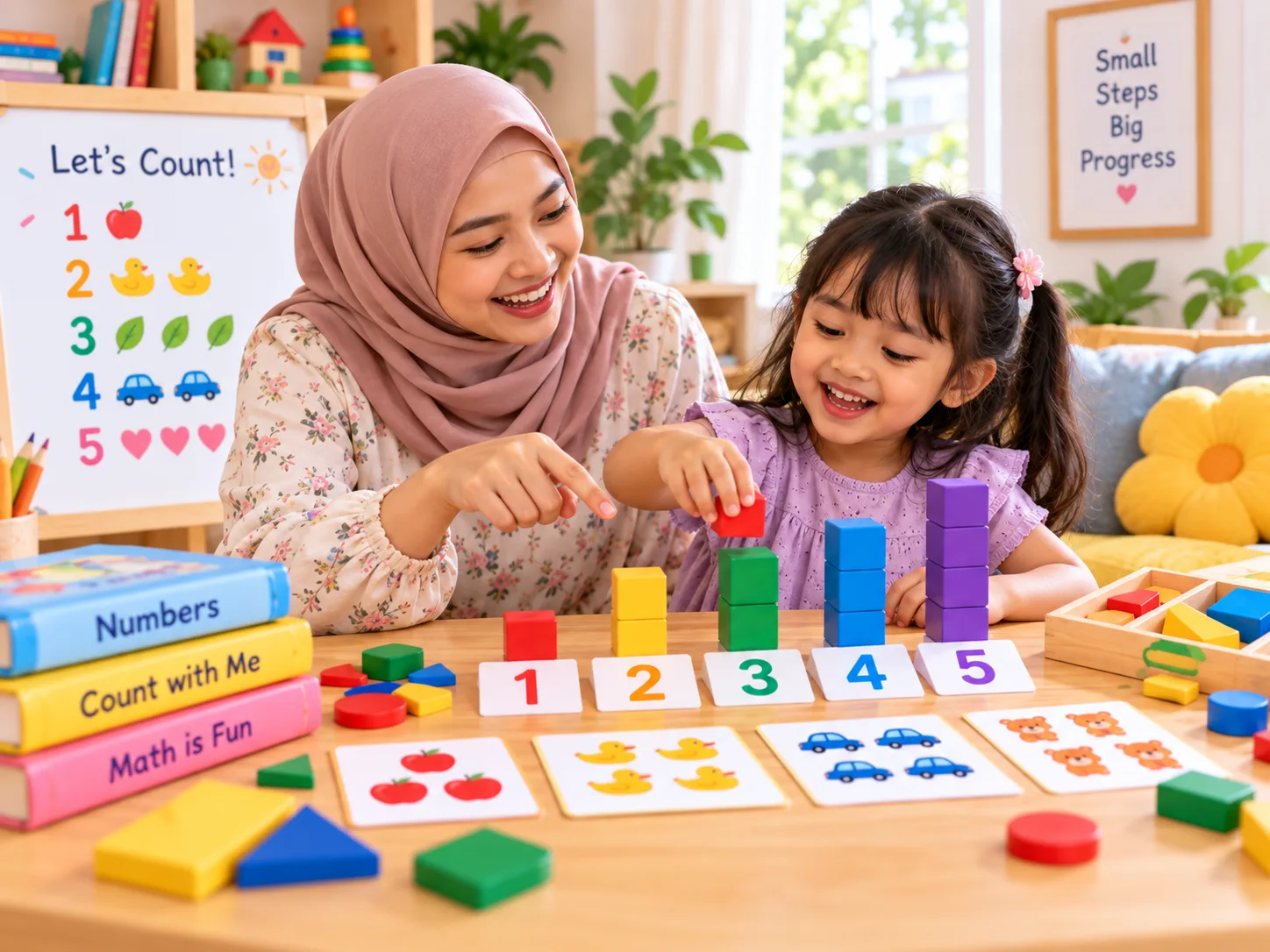
Many parents want to support children with early counting, but useful learning does not have to look like a formal lesson. A stronger starting point is to understand quantity with real objects before relying only on number symbols. When an activity feels connected to everyday life, children have more chances to understand why they are doing it instead of simply following instructions.
Try practical ideas such as counting snacks, toys, steps, blocks, fingers, and everyday objects while moving or playing. Begin with one or two activities rather than many targets at once. Children of the same age can differ in language, experience, confidence, coordination, and attention span, so progress does not need to look identical.
Start with a small, observable goal
Choose a goal that is realistic and easy to notice. Instead of a broad instruction such as “study harder,” aim for one clear outcome: explain one idea, try one new strategy, complete one short step, or use one new word. If it goes well, add difficulty gradually. If it feels too hard, make the next step smaller.
Use conversation, not only instructions
Children learn a great deal when they are invited to explain what they see and think. Questions such as “What do you notice?”, “Which part feels difficult?”, “How do you know?”, or “Is there another way?” create room for reasoning. Adults can gently expand a child’s answer without turning the conversation into a test.
Connect learning with real objects and experiences
Ideas are easier to remember when children meet them in more than one situation. After a book, video, worksheet, or digital game, look for the same concept at home or outdoors. Moving from a screen or page to real objects helps children see that knowledge can be used, not only answered.
Give just enough help
Support does not mean giving the answer every time a child pauses. Wait a few seconds, invite them to look again, narrow the choices, or demonstrate only the first step. Reduce help as understanding grows. Praise specific effort—careful observation, trying again, or explaining an idea—rather than only correct answers.
Notice when a break is needed
Repeated mistakes, constant distraction, silence, frustration, or anger can signal that the task has become too long or too difficult. A break is not a failure. A drink, a short movement activity, or a simple household task can make the transition easier before deciding whether to continue.
Use digital media actively
Games and videos can support early counting, especially when adults know what children are watching or playing. Choose content with a clear purpose, suitable language, and simple navigation. Afterwards, ask children to show the idea again through a picture, object, movement, or story so the screen becomes one part of a wider learning experience.
Match the activity to the child
Age is only one guide. If an activity is too easy, ask for a reason, a new example, or a different solution. If it is too difficult, reduce the number of choices, show the first example, or use more concrete objects. Small adjustments are often more effective than pushing through material a child is not ready for.
Look for progress in everyday behaviour
Progress is not always visible on a score sheet. Notice whether a child uses new words, recognises patterns faster, tries again after a mistake, follows a short sequence of instructions, or connects an idea with another experience. Brief notes can help parents see change over time without making children feel constantly assessed.
Keep the routine simple
Start with a short introduction, continue only while the child is engaged, and finish with a brief conversation. Ask one thing they enjoyed and one thing they would like to try again. Repeating the same idea later with a different example builds familiarity without making the activity feel identical.
Conclusion
There is no single method that fits every family. Use these ideas as a starting point, watch the child’s response, and adjust the difficulty or duration when needed. The aim is to make early counting understandable, discussable, and connected with everyday life. Bebiyu can provide games and learning materials as companions, while adult involvement remains important whenever children need explanation, boundaries, or emotional support.